


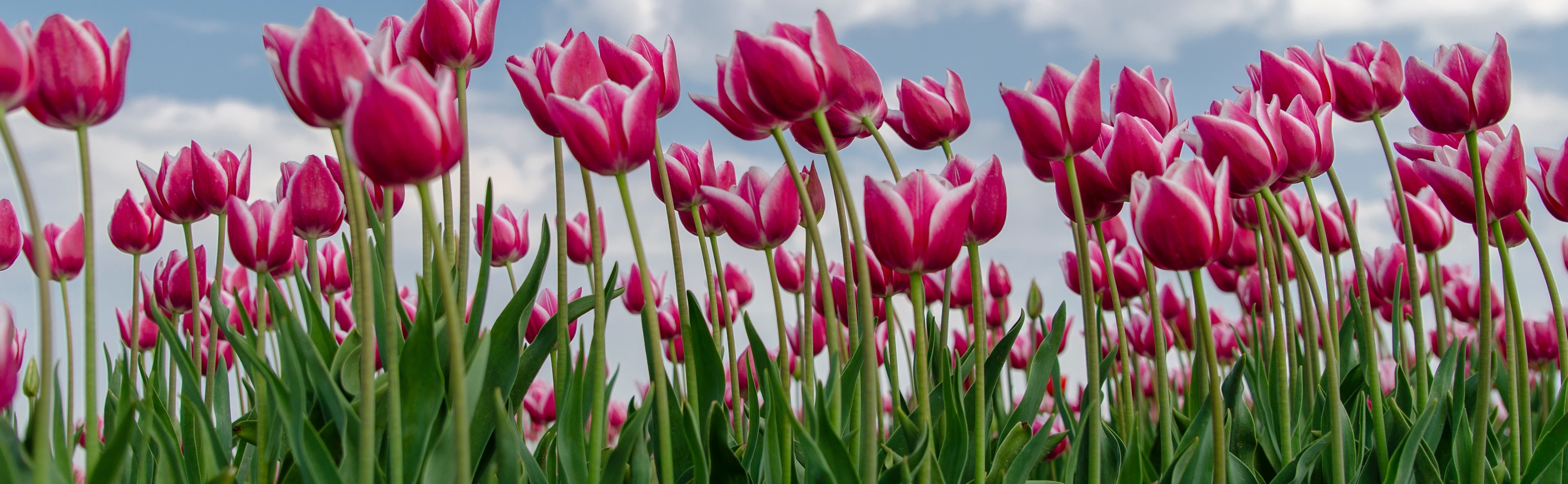
Why we Love Tulips in our Bouquets
Tulips are one of the most popular flowers in bouquets, whether as a stand-alone flower or as part of a more complex arrangement. Every florist you know can tell you that their clients can’t get enough of these fragrant, beautiful blooms.
But why? This article will explain some of their reasons for the popularity of tulips, as well as guide you through the origins and history of one of Europe's most famous flowers.
1. Where are Tulips from?
Around half of the 120 Tulip species whose existence is known to us are from Central Asia, an area of the world where flowers thrive in extreme weather conditions: from freezing winters and baking summers.
Indeed, tulips have been traditionally cultivated in Eastern Europe and Turkey for centuries.
We’ll go more into the history of tulips later in this blog, but in Europe Tulips are primarily associated with the Netherlands, the country which most likely introduced the flower to Europe in the 17th century.
2. How easy are Tulips to care for?
Because of the tough environment of where they are from, Tulips are incredibly easy to care for. They are hardy, tough flowers that will thrive in most conditions.
That said, there are still things you can do to care for your beautiful bouquet of tulips to ensure they last for the maximal length of time.
Tulips prefer a deep pot with rich soil and can be planted indoors or outdoors. They need a sunny spot to bloom their best and require plenty of water.
Cut tulips are also easy to care for; they merely require a regular changing of the water and the occasional trimming of stems.
3. How long do Tulip bouquets last?
A well-cared-for bouquet of cut tulips has a vase life of 7-10 days.
This is fairly long compared to other flowers.
4. Why Tulips are so popular in bouquets
Floral bouquets are a common sight at weddings, celebrations of birthdays, and anniversaries.
Why do we associate tulips with these occasions, and why do we turn to tulips to fill out any good floral selection?
One reason is because tulips are one of the longest lasting flowers that you can find in stores or floral shops, which makes them very popular among floral consumers.
And another reason tulips are so popular is because they come in so many different colours and sizes that they can go with many other kinds of flower, and can be used to complement a variety of symbolic meanings of other flowers.
5. What do Tulips symbolise
As well as practical reasons for their popularity, the symbolic meaning of tulips also forms a significant reason as to why they are so popular.
They also contain a range of symbolic meanings. Firstly, tulips are considered a symbol of "sentimentality and fragile beauty." They also symbolize “the fragility of life.” Particularly in the 18th century, tulip bulbs were an expensive commodity, as they were rare.
The Dutch called the tulip the flower of prosperity because these flowers signalled great wealth for those who could afford to purchase them.
Many of these meanings have lingered over the centuries to the day and have also become mixed with meanings of youth and innocent love.
In the 21st century, you can communicate a variety of meanings to your friend, family member, or romantic partner by gifting them a bouquet that uses tulips.
We have an extensive range of bouquets available for same-day Birmingham Flower Delivery, with next-day delivery available in the rest of the UK.
6. The History of Tulips
Tulips are native to Eastern Europe and Asia Minor, but the Dutch were the first to introduce them to Europe.
Tulips became a popular addition to formal gardens in the early 1600s because of their novelty compared to the more traditional roses or daisies.
It wasn't until 1637 when the fashion for tulips got out of hand with what historians now call "tulip mania”, which was one of the world’s first speculative economic bubbles. At the height of the bubble, people were so obsessed tulips that one single oil painting of a tulip was priced at 10 times more than actual bulb itself!
But the fascinating history of tulips does not end there.
Tulips also took over fashionable circles in the 18th century Ottoman Empire, in a period of relative peace and prosperity three centuries ago known as the ‘tulip period’ when courtiers and noblemen spent lavishly on new breeds of tulips.
In fact, during their early days as a garden plant they were popular for medicinal purposes such as snake bites and typhoid fever treatments.
The 19th-century brought about an era where rockeries became incredibly popular; but these days it's mainly because people have grown to appreciate them for their foliage rather than any perceived healing properties.
The 20th Century ushered in Frits Zernik,who was a young scientist who used tulips while conducting experiments on light polarization. These experiments would would lead him down his career path which eventually led him to discover the microscope and winning the Nobel Prize for Physics in 1953.
Conclusion
If you want to thank someone for their help, or just brighten up a friend's day, tulips are the perfect flower. From Holland and Germany to North America, these beautiful bulbs have been loved by people around the world for centuries.
They have also played an outsized role for a humble flower in European politics, economics, and science.
Tulip flowers come in every colour of the rainbow and range from small bouquets to large displays that fill entire gardens with blossoms.
To get your hands on one of this season’s most popular blooms-or any other type of flower for that matter-contact us today!