


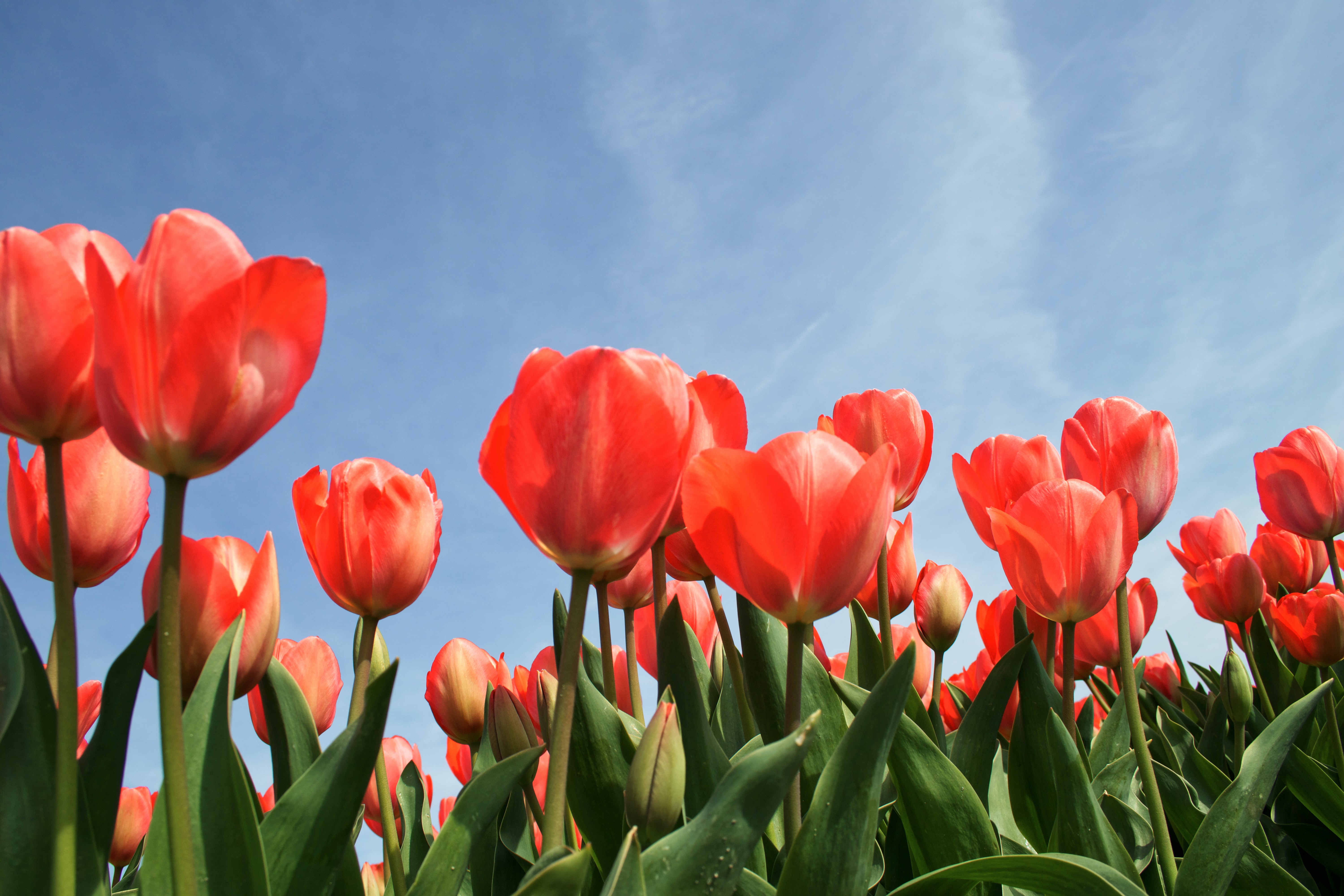
Three reasons why everybody loves tulips
Tulips are beautiful flowers with two petal-like leaves that bloom for a short period in Spring. The tulip flower is native to the mountains of Central Asia, and is related to several other plants, including gardenia, magnolia, and dogwood.
Tulips were bought to Europe 450 years ago by a biologist called Carolus Clusius, and they’ve been one of Europe’s most popular flowers since.
This blog will take you through the basics of why tulips are one of the most beloved plants
1) They come in a vast range of colours and shades
Part of the appeal of tulips lies in their leaf colour which ranges from deep red through orangey-red, yellowish-green to purplish varieties; many varieties also have subtly different shades on the underside of the leaves.
The one colour in which it is impossible to cultivate naturally is blue!
There are around 150 species of tulips, and 3000 naturally occurring and genetically cultivated varieties of the flower worldwide.
Depending on the variety, they might also be hot pink, orange, or dark purple. You will find that each colour has different names.
Pink tulips are called ‘neon’, red ones are known as ‘tango’ or ‘red fantasy’ while cream or yellow flowers have names like 'sunshine' or 'honey bar'.
It can be confusing for gardeners who do not already know the language used to describe them, but it is not too tricky if you keep your eyes open for the name tags attached to many varieties.
Because tulips come in a wide variety of colours, this allows them to have a wide variety of meanings. Red tulips often connote love, violet ones reflect strength or appreciation, and pink tulips represent gratitude.
In some areas of the world, red tulips are said to symbolize death while yellow ones stand for help and emotional support.
Very often these colours are not just restricted to planting in a vase on your mantelpiece. They can also be seen decorating wedding cakes, dress fabrics and even invitations in their respective colours.
The term ‘paperwhite’ refers to a range of white flowering plants that includes narcissus and cyclamen species. Paperwhite narcissus cultivars produce large clusters of fragrant blooms reminiscent of hyacinth flowers around the time of Christmas.
2) They have a rich and fascinating history
Tulips are native to eastern Europe and Asia Minor, but the Dutch were the first to cultivate them as an ornamental flower, introducing them to Europe around 1568.
In the 17th century, tulip mania overtook the Dutch Republic and ended with a crash that ruined many. At the height of the bubble in 1637, an oil painting of a tulip was said to be worth more than an actual bulb itself.
The fascinating history of tulips does not end there with the Dutch in the 17th century. During the 19th century, tulips were popular for their medicinal properties – they were used in the treatment of a range of illnesses and conditions including snake bites, typhoid and high blood pressure
Their popularity as a garden plant began with Victorian rockeries (which are still incredibly popular today) but these days they are grown to be appreciated for their foliage rather than any perceived medicinal properties.
And in the 20th century, tulips were used by a young Dutch scientist, Frits Zernike, to invent the world's first high-power microscope.
3) Tulips are easy to grow and crossbreed
Tulips are also popular because they are incredibly easy to grow for yourself. Tulips need full sun to thrive, and they dislike being planted in areas of the garden that receive particularly poor drainage.
Soil should be loosened and watered when dry, not too wet or the roots will rot. The bulb needs to be firm, but not fat or it will not bloom well; roots need space to spread out and develop, so make sure there is some room at the bottom of the container- do not cram them in.
Some people plant tulip bulbs upright in pots that have drain holes because this way they only need to water moderately since ground moisture does not seep into the soil as quickly as moisture from watering overhead does.
A planted pot would probably require more care--by digging it up after winter dormancy.
Conclusion
The tulip is known as an easy-to-grow plant that thrives in temperate climates.
From their history across Asia and Europe, to the wide variety of colours and species available, the flower has many facets, and so despite its simple shape it has a very complex character
In addition to being beautiful flowers with rich symbolism for those who believe in it, the tulip can be used medicinally or eaten by humans too!
We hope these facts about the common garden flower will inspire you to try your hand at growing them yourself or purchasing a fresh beautiful bouquet of them.
We have a variety of bouquets available for same-day Birmingham Flower Delivery.