


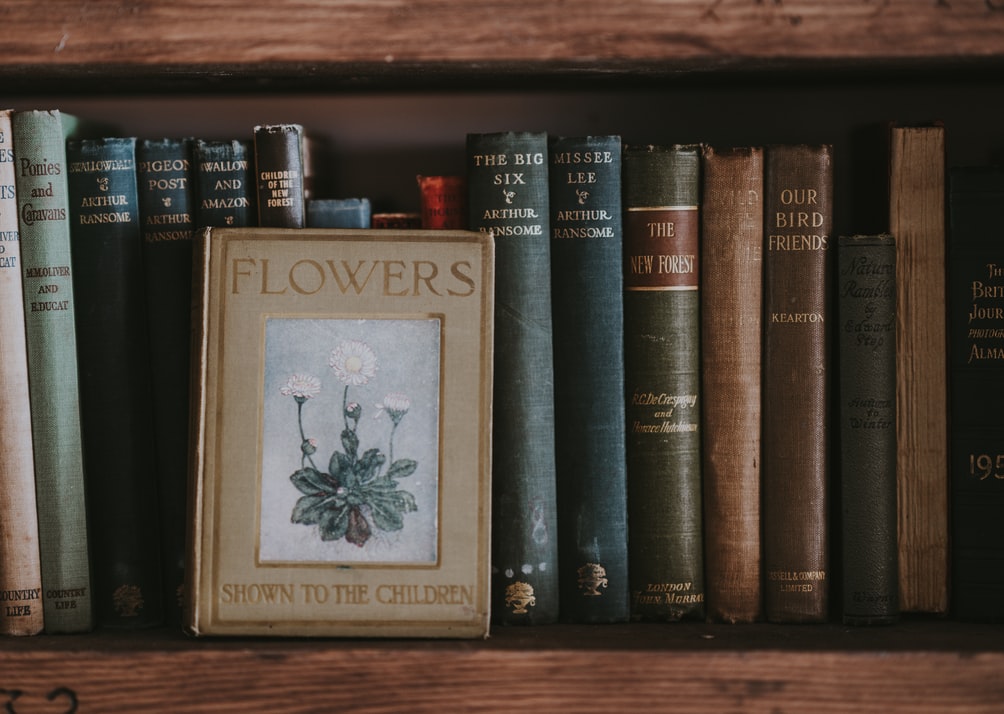
Floral Literature and metaphor in the western canon
As well as communicating meaning through being gifted to potential romances, friends and family members, flowers and floral names have been used as literary devices for as long as there has been a storytelling tradition.
This blog will look at six examples of works that use floral metaphors to convey deeper meanings, whether they be the internal torment of protagonists or the fate of nations.
1.The Bible
“I am a Rose of Sharon, a lily of the valleys” - Song of Songs 2:1 (KJV)
By far the most influential book in western, if not world literature, the Bible has also contributed to the modern naming of several flowers.
The Songs of Songs is an allegorical dialogue between a bride and bridegroom, and in the second chapter, the female narrator compares herself to a ‘Rose of Sharon’, a phrase used to convey both her beauty and fragility.
Due to difficulties in translating from the original Hebrew, it is unclear which species of flower the narrator was referring to specifically, with some speculating it was a crocus, others a jonquil.
Biblical scholars agree that there is no chance it was referring to the modern species of rose.
A rose of Sharon is now used as a shorthand for many different species of flowers including Hypericum calycinum (Aaron's beard) and Hibiscus syriacus.
The blooming of fragile flowers in the wilderness is also a metaphor used in Isaiah 35, to represent the return of Israel from the Babylonian captivity.
2.Henry VI Part 1 - William Shakespeare
“Stay, lords and gentlemen, and pluck no more.” - Act 2, Scene 4
In William Shakespeare’s historical play, Henry VI part 1, as the king’s reign goes from bad to worse, powerful magnates meet in the gardens of Temple Law School in London to pluck red and white roses.
During the civil war (1455-1485), armies would go into battle bearing the emblem of either the red rose of Lancaster or the white rose of York.
The conflict was not called ‘the war of the roses’ until Walter Scott coined the phrase in the 19th century, but Shakespeare and other writers like David Hume used red and white roses in literary accounts of the conflict prior to that.
At the end of the conflict, the Lancastrian Henry VII married Elizabeth of York, bringing together the red and white rose in a new Tudor Emblem.
Today, gifting a loved one a bouquet of mixed roses is a way of indicating unity and togetherness after a difficult dispute.
3. Mansfield Park - Jane Austen
“It was cutting the roses, and dawdling about in the flower-garden, that did the mischief” - Chapter Seven.
As well as the physical scene of courtship and romance between her various characters, Jane Austen uses the language of flowers to help readers understand the characters' feelings towards themselves and others.
Different flowers can have different meanings and connotations, and you will see these meanings pop up again and again in her novels.
In Mansfield Park, for example, when Mr. Rushworth is thawing out from being angry with General Tilney for wanting to marry his sister, he gives an envelope containing a bouquet of daisies to Eleanor on her birthday which means he does not want her treated harshly in any future union with Tilney.
This indicates Mr. Rushworth's support for Eleanor
4.Oscar Wilde - The Picture of Dorian Gray
“Time is jealous of you, and wars against your lilies and your roses”. Chapter Seven.
In Oscar Wilde’s late nineteenth century gothic thriller The Picture of Dorian Gray, Lord Henry tells Dorian at the start of the novel that his youth will be fleeting, using the metaphor of flowers in the field.
Unable to take this, Dorian buries his face in the lilacs, absorbing their beauty and fragrance, symbolising his desire to constantly remain young and beautiful.
Dorian Gray consistently wears white flowers throughout his narrative arc novel to demonstrate his outward innocence, much like his physical beauty, this is merely a mirage.
5. John Steinbeck - The Chrysanthemums
“The chrysanthemum stems seemed too small and easy for her energy”
The Chrysanthemums is a short novel by Steinbeck and was published in 1935, a year before Steinbeck's most famous piece of literature The Grapes of Wrath.
The story follows two protagonists through alternating chapters: Elisa Allen, the daughter of an amateur horticulturalist; and Johnny Dowdle, the son of poverty-stricken apple growers.
The strong, long and tough stems of Chrysanthemums are symbolic of Elisa's masculine qualities that she exhibits throughout the novel as she overcomes the challenges of alienation and economic hardship, two common themes in the works of John Steinbeck.
6. J.K Rowling - Harry Potter
One of the most influential and popular fiction franchises in the 21st century, the mother of Harry Potter is called Lily, and his aunt, who raises him, is called Petunia.
While Lilies have heavenly connotations, and this is reflected in the story by the divine protection placed on Harry by his mother after her sacrifice to save him.
Severus Snape, who bears for his entire life an unrequited love for Lily, even after her death, severs the relationship Lily has with his non-magical sister Petunia by turning them against each other.
Petunia is a flower which in the Victorian language of flowers, can symbolise harshness and anger. Harry’s aunt takes her rejection from the magical world harshly by attempting to insulate Harry from it, even obfuscating the circumstances of his parents’ death.
There are also other floral names in Harry Potter which communicate significance about the characters. Myrtles are considered to be the flower of love, and Moaning Myrtle, the ghost in the school toilets is constantly trying, and failing, to fall in love with male school pupils.
And Lavenders are a flower which connotes devotion; Lavender Brown in the sixth novel is devoted, possibly to a fault, to Ron Weasley which causes issues in the latter’s friendship with Hermione.
Conclusion
We hope this deep dive into the use of floral metaphors in literature will inspire you to think about the deeper meaning of flower bouquets the next time you make a purchase.
Flowers are often used in literature as a representation of deeper meanings. You may not have thought about it before, but the flowers you buy can say more than just "I love you”, or for a friend “I am here to support you”.
Consider all the different flower bouquets we offer when choosing your next gift for that special someone- if they are into symbolism, there is sure to be something here!
All bouquets we sell are available for next-day Birmingham Flower Delivery with next-day delivery for the rest of the country!